NDB’s Third Quarter: A Strong Core, a Costly Lesson in Governance
Profits are back on track and capital is comfortable. But a Rs. 13.64 billion fraud, a thinner low-cost deposit base and a share price still well below last year’s level show the recovery is unfinished.
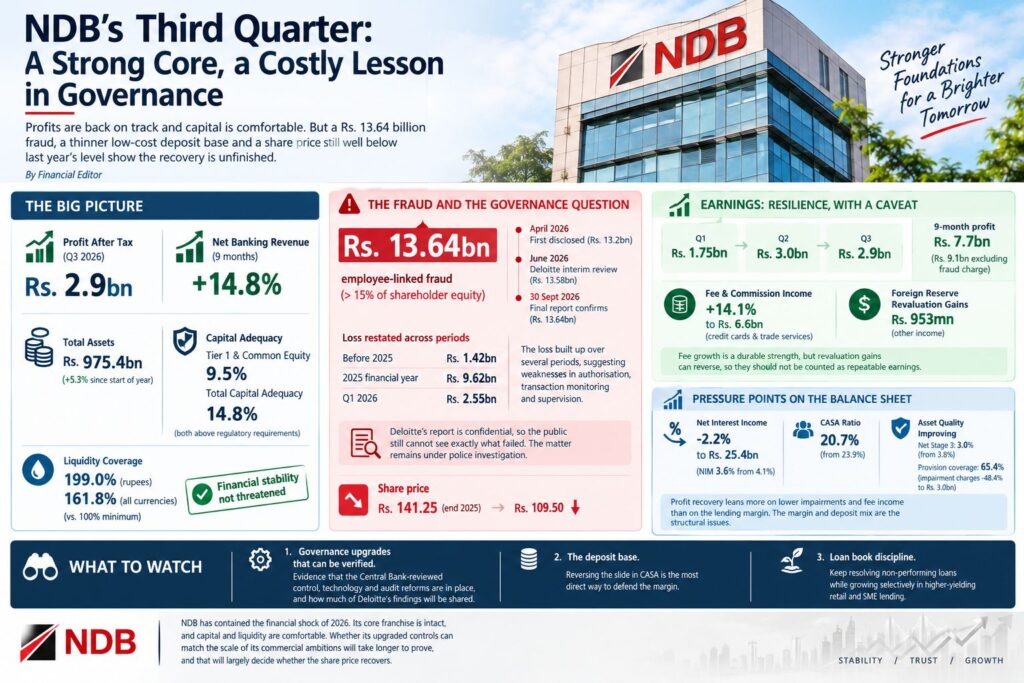
National Development Bank PLC’s third-quarter results for 2026 tell two stories at once. The first is of a lender whose core business kept earning through a crisis: profit after tax of Rs. 2.9 billion for the quarter, and net banking revenue up 14.8% over nine months. The second is of a bank still absorbing one of the largest internal frauds ever reported by a listed Sri Lankan bank, which at Rs. 13.64 billion is equivalent to more than 15% of its shareholder equity.
The fraud and the governance question
NDB first disclosed an employee-linked fraud in April 2026 and put the exposure at Rs. 13.2 billion. Deloitte Touche Tohmatsu India’s interim review raised the figure to Rs. 13.58 billion in June, and its final report, disclosed on 30 September, confirmed Rs. 13.64 billion. The bank restated earlier results to reflect the loss: Rs. 1.42 billion to periods before 2025, Rs. 9.62 billion to the 2025 financial year and Rs. 2.55 billion to the first quarter of 2026.
That the loss built up across several reporting periods, and forced a restatement of 2025, suggests weaknesses in authorisation, transaction monitoring and supervision. The bank says no customer lost money, that Deloitte’s findings broadly match its own investigation, and that it is acting on recommendations covering governance, control failures and technology lapses under the Central Bank’s oversight. The matter remains under police investigation.
The Deloitte report is confidential, so the public still cannot see exactly what failed. That is the main open question for shareholders, and the market has noticed. The share price has fallen from Rs. 141.25 at the end of 2025 to Rs. 109.50.
Earnings: resilience, with a caveat
Quarterly profit went from Rs. 1.75 billion in the first quarter to Rs. 3.0 billion in the second and Rs. 2.9 billion in the third. That brings reported nine-month profit to Rs. 7.7 billion. Excluding the fraud charge, the figure would have been Rs. 9.1 billion, against Rs. 7.5 billion a year earlier.
Net fee and commission income rose 14.1% to Rs. 6.6 billion, driven by credit cards and trade services. Foreign reserve revaluation gains of Rs. 953 million also helped other income. Fee growth is a durable strength, but revaluation gains can reverse, so they should not be counted as repeatable earnings.
Pressure points on the balance sheet
Total assets reached Rs. 975.4 billion, up 5.3% since the start of the year. Beneath that, the margin is under pressure:
Net interest income slipped 2.2% to Rs. 25.4 billion, and net interest margin fell to 3.6% from 4.1% in 2025. This reflects Sri Lanka’s low-rate environment and the lag between repricing assets and liabilities.
The CASA ratio (current and savings accounts) fell to 20.7% from 23.9% at the end of 2025, as depositors favoured fixed-return term deposits. Low-cost deposits matter for protecting the margin.
Asset quality improved. The net Stage 3 ratio fell from 3.8% to 3.0%, provision coverage rose to 65.4%, and impairment charges dropped 48.4% to Rs. 3.0 billion.
Taken together, the profit recovery leans more on lower impairments and fee income than on the lending margin. The margin and deposit mix are the structural issues.
Capital and liquidity
NDB’s Tier 1 and common equity ratio stands at 9.5%, and total capital adequacy at 14.8%, both above regulatory requirements. Liquidity coverage is 199.0% in rupees and 161.8% across all currencies, against a 100% minimum. The bank can absorb the shock, and the numbers back its repeated statements that the fraud does not threaten its stability.
What to watch
Governance upgrades that can be verified. Investors will want evidence that the Central Bank-reviewed control, technology and audit reforms are in place, and how much of Deloitte’s findings will be shared.
The deposit base. Reversing the slide in CASA is the most direct way to defend the margin.
Loan book discipline. NDB must keep resolving non-performing loans while growing selectively in higher-yielding retail and SME lending.
NDB has contained the financial shock of 2026. Its core franchise is intact, and capital and liquidity are comfortable. Whether its upgraded controls can match the scale of its commercial ambitions will take longer to prove, and that will largely decide whether the share price recovers.
By Financial Editor