SRI LANKA’S NEED FOR A NATIONAL SCHOOL OF DIPLOMACY FOR STATE’S SUCCESS FOR NEXT 100 YEARS AND BEYOND
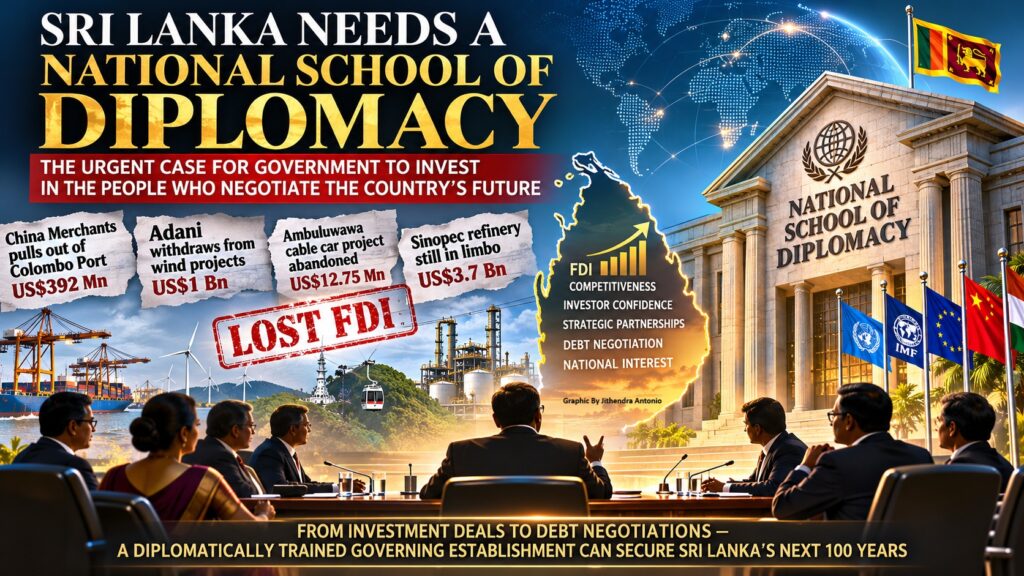
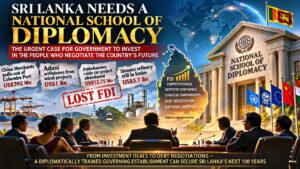
THE URGENT CASE FOR GOVERNMENT TO INVEST IN THE PEOPLE WHO NEGOTIATE THE COUNTRY’S FUTURE
“From ministers and parliamentarians to ministry secretaries and administrative service officers, Sri Lanka must establish an internationally benchmarked institution to develop the diplomatic, geopolitical, economic, legal and strategic negotiating capabilities of its governing establishment. Hambantota, abandoned investments, stalled multibillion-dollar projects and the country’s sovereign debt crisis demonstrate why diplomatic education can no longer remain an exclusive domain of career diplomats.”
By Jithendra Antonio
Sri Lanka is spending billions attempting to attract foreign investment, negotiating with international creditors, seeking economic partnerships and positioning itself as an Indian Ocean investment destination. Yet the country continues to overlook one of the most important investments it needs to make: educating the people who negotiate, administer and govern on its behalf.
Where is the institution that systematically trains Sri Lankan ministers, parliamentarians, ministry secretaries, administrative service officers and senior public officials to negotiate with foreign governments, multinational corporations, international financial institutions and sovereign creditors?
Sri Lanka has diplomatic missions, foreign policy researchers and conventional public administration training institutions. But it needs something more ambitious: an internationally benchmarked National School of Diplomacy, dedicated to developing professional competence in international negotiations, geopolitical strategy, global economics, international law, trade, investment and strategic governance.
This is not simply about producing better diplomats. It is about preventing the country’s governing establishment from entering billion-dollar international negotiations without adequate institutional preparation.
THE PRICE OF FAILED NEGOTIATIONS – BILLIONS IN INVESTMENT OPPORTUNITIES
Sri Lanka’s recent investment experience provides an uncomfortable illustration of why institutional competence and negotiating preparedness matter.
In October 2026, China Merchants Port Holdings withdrew from a proposed US$392 million commercial and logistics hub at Colombo Port. The proposed joint venture involved a 70% stake for the Chinese company, with the Sri Lanka Ports Authority and Access Engineering holding 15% each. The project, originally announced in 2023, was intended to strengthen Colombo’s position as a regional logistics and maritime hub.
The Sri Lanka Ports Authority subsequently indicated that it would seek another investor. China Merchants clarified that the decision concerned the proposed project, not its existing investments and operations in Sri Lanka. The withdrawal was attributed to prevailing external circumstances, commercial considerations and shareholder interests.
In January 2026, another investment setback emerged when China’s Amber Adventures formally withdrew from the Ambuluwawa Cable Car Project, notifying the Board of Investment of its decision.
The proposed investment was valued at US$12.75 million, of which the company said approximately US$3.5 million had already been invested. The company cited regulatory obstruction, suspension of construction and actions by state authorities as reasons for its withdrawal. It also indicated that it was considering international legal action.
These are the investor’s allegations, not an independently established finding of regulatory misconduct. Nevertheless, the case raises serious questions about regulatory coordination, investor protection and the ability of government agencies to resolve project disputes before investments collapse.
Then came Adani Green Energy’s withdrawal in February 2025 from its proposed 484 MW wind energy projects in Mannar and Pooneryn.
The projects were initially associated with an investment commitment of approximately US$1 billion, although reporting on the power project itself also cited a value of around US$400–442 million. The disagreement centred on the proposed electricity tariff of 8.26 US cents per kilowatt-hour and the Sri Lankan Government’s effort to negotiate a lower price.
The government maintained that it was seeking better electricity prices for consumers. Adani subsequently withdrew rather than accept the proposed change to the agreed commercial terms.
These cases are different. They should not all be attributed to diplomatic failure or treated as equivalent losses. But collectively they demonstrate why governments need highly trained officials capable of negotiating commercially viable agreements, coordinating regulators, resolving disputes and maintaining investor confidence.
THE US$3.7 BILLION QUESTION – SINOPEC AND THE COST OF PROLONGED NEGOTIATIONS
Perhaps the most consequential example is the proposed Sinopec oil refinery in Hambantota.
The US$3.7 billion project, with a planned processing capacity of 200,000 barrels of crude oil per day, was presented as potentially the largest foreign direct investment in Sri Lanka’s history.
Yet negotiations became entangled in disagreements over the proportion of refined products permitted for domestic sale. Sri Lanka’s original position limited domestic sales to 20%, requiring 80% of production to be exported. Sinopec sought greater access to the local market, alongside discussions concerning land, tax concessions and water availability.
By July 2026, the government had still not reached a final decision, and the project remained without confirmed implementation.
The fundamental question is not whether the government should accept every demand made by an investor. It absolutely should not.
The question is why critical commercial, regulatory and operational conditions cannot be resolved with greater certainty and efficiency before multibillion-dollar projects are promoted as major investment achievements.
A professionally trained negotiating team should identify these issues during the initial tender and contractual negotiations, evaluate competing commercial interests and establish clear, enforceable terms.
A US$3.7 billion investment announcement is not US$3.7 billion of realised FDI.
Sri Lanka must learn to measure investment by capital actually deployed, projects completed, jobs created and foreign exchange generated—not merely by agreements signed and headlines published.
A COUNTRY THAT CANNOT RETAIN INVESTMENT CANNOT COMPETE FOR IT
The problem extends beyond individual projects.
Sri Lanka’s historical FDI inflows have generally remained around 1.5%–2% of GDP, compared with approximately 5%–6% for Vietnam, according to the attached policy analysis.
The difference is not simply geographical advantage. It reflects the importance of investment facilitation, export-oriented industrial policy, regulatory predictability, international commercial relationships and the ability to negotiate mutually beneficial investment arrangements.
Sri Lanka has repeatedly offered tax concessions and investment incentives without always securing sufficient technology transfer, research and development, export integration and domestic economic value.
The country needs officials who understand how multinational corporations make investment decisions, how international investment treaties operate, how arbitration provisions can expose governments to liabilities and how to structure concessions without sacrificing long-term national interests.
WHY EVERY MINISTER AND SENIOR PUBLIC OFFICIAL NEEDS DIPLOMATIC EDUCATION
Diplomacy cannot remain the exclusive responsibility of the Foreign Ministry.
A finance minister must understand sovereign debt and international capital markets. An energy minister must understand international energy agreements and project financing. A ministry secretary must be able to scrutinise contractual obligations and international concessions. An administrative service officer must understand multilateral development programmes and international regulatory frameworks.
The proposed school should provide mandatory strategic orientation for newly appointed ministers, advanced executive programmes for ministry secretaries and senior administrative service officers, and specialised international relations and treaty education for parliamentarians.
Its curriculum should cover international law, sovereign debt restructuring, geopolitical strategy, bilateral investment treaties, international arbitration, global trade, FDI negotiations, maritime security, economic diplomacy, sanctions compliance and international communications.
Training must extend beyond lectures. Participants should undertake simulated negotiations involving billion-dollar infrastructure agreements, international investment disputes, sovereign debt restructuring and diplomatic crises.
The objective is to ensure that those making decisions understand the consequences before agreements are signed.
BUILD AN INTERNATIONALLY CONNECTED INSTITUTION WITHOUT ANOTHER TREASURY BURDEN
Sri Lanka should develop the school through an independent statutory framework, supported by international partnerships and institutional capacity-building grants.
Potential partners include the United Nations Institute for Training and Research, the Asian Development Bank, the Commonwealth Secretariat, the Geneva Centre for Security Policy, Singapore’s Civil Service College and the Clingendael Institute in the Netherlands.
International faculty, former ambassadors, experienced IMF and World Bank negotiators, international arbitration practitioners and senior public administrators should contribute to its programmes.
A professionally governed endowment, philanthropic contributions and bilateral technical assistance could support its establishment and operations, reducing dependence on recurrent Treasury allocations.
Existing institutions, including the Lakshman Kadirgamar Institute and the Bandaranaike International Diplomatic Training Institute, should be recognised as potential collaborators. The proposed school should complement their work rather than unnecessarily duplicate it.
Its governing board must be professionally independent, its appointments merit-based and its performance subject to transparent annual reporting.
THE MOST IMPORTANT NATIONAL INVESTMENT MAY BE IN THOSE WHO SIGN THE AGREEMENTS
Sri Lanka has already witnessed what happens when infrastructure financing, sovereign borrowing, investment negotiations and international commitments are not supported by sufficient long-term institutional preparedness.
Hambantota, the 2022 sovereign default, Adani’s withdrawal, the Ambuluwawa investment dispute, China Merchants’ abandoned logistics hub and the continuing uncertainty surrounding Sinopec should provoke a serious national conversation.
None of these cases has an identical cause, and a diplomatic school cannot guarantee that every investor will stay or every negotiation will succeed. But a professionally prepared governing establishment can improve the quality of decisions, reduce avoidable contractual and regulatory mistakes, strengthen interministerial coordination and protect the credibility of the country.
The Government must initiate a formal feasibility study and develop a national implementation framework for an internationally benchmarked School of Diplomacy and Strategic Governance.
Sri Lanka cannot continue spending billions on economic recovery while underinvesting in the professional capabilities of those entrusted with negotiating that recovery.
The next time a foreign investor, sovereign creditor or multinational corporation sits across the table from Sri Lanka, the country must arrive with more than political authority and diplomatic protocol. It must arrive with institutional intelligence, technical knowledge and negotiating expertise.

A nation that does not train its negotiators risks paying for their mistakes through lost investments, unfavourable agreements and diminished economic opportunities.
Sri Lanka needs a National School of Diplomacy. Not another institution to issue certificates, but a national institution to prepare those who govern the country to negotiate its future.
(The writer is a Consultant specialised in Data Analytics with a Special Focus on Sri Lanka’s Future Direction, and in the fields of Sustainable Energy, ESG, Investments and telecommunications. He can be reached at [email protected].)